

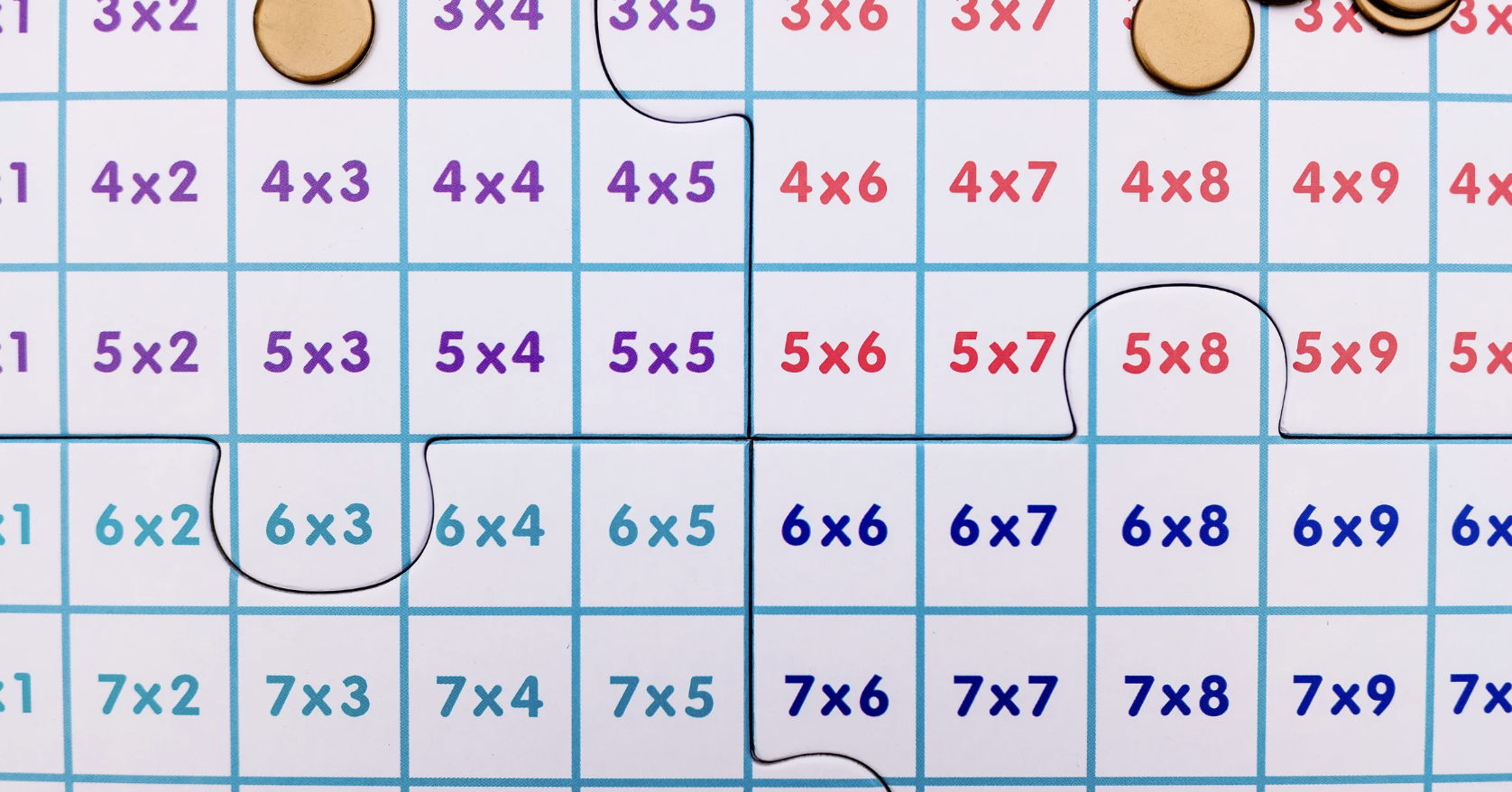
When most people hear the word multiplication, they think about memorizing times tables, those familiar grids of numbers we all practiced endlessly. While knowing your multiplication facts is incredibly important, multiplication itself is much more than that.
In our very first lesson of NGEN Math 6, we dive into the meaning behind whole number multiplication: what it represents, how it is modeled, and why it connects so beautifully to geometry.
Multiplication Begins with Repeated Addition
Let’s start simple. Imagine Ian saves $5 each day for a week. After seven days, how much money does Ian have?
You could add:
5 + 5 + 5 + 5 + 5 + 5 + 5
That is addition repeated seven times. But somewhere along the way, mathematicians realized that instead of writing the same number over and over, we could think of this as seven groups of five. That is what multiplication really is, counting equal groups quickly and efficiently.
So, in Ian’s case:
7 Ă— 5 = 35
He saves $35 in total.
It’s a simple idea, but it is also the foundation for how multiplication shows up everywhere, from counting money to calculating distances to figuring out the area of a shape.
Follow Along with the Lesson
As we explore these concepts you can follow along in our teacher guided lesson video.
The Buckets and the Stuff Inside
We like to tell students to think of multiplication as having buckets, or groups, and then the stuff inside each bucket.
In Ian’s savings example:
- The buckets are the days (7 total)
- The stuff inside each bucket is the $5 he saves per day
Multiply to find out how much stuff you have altogether:
7 buckets Ă— 5 dollars each = 35 dollars total.
This model works for nearly every multiplication problem you will ever see, whether you are counting squares, money, or miles.
Why Knowing Your Facts Still Matters
While it is important to understand multiplication, it is also essential to know your basic multiplication facts, ideally from 1Ă—1 through 10Ă—10, and if you can, up through 12Ă—12.
Think of it like learning to read. At first, you sound out every word slowly. Eventually, you recognize them instantly, and that is when reading starts to flow. Multiplication is the same. Once your times tables are second nature, your brain is free to focus on bigger ideas and more complex problems.
So yes, practice those facts. They are your math “sight words.”
The Connection Between Multiplication and Area
One of my favorite ways to show the meaning of multiplication is by connecting it to the area of a rectangle.
Suppose you have a rectangle that is 4 inches long and 3 inches wide. If you draw a grid inside that rectangle, dividing it into 1-inch squares, you will find that there are 12 little squares inside.
Each of those squares represents one square inch, a unit of area.
So how do we get that 12 without drawing all the squares?
Simple: multiply the length by the width.
Area = Length Ă— Width
Area = 4 inches Ă— 3 inches = 12 square inches
That is multiplication in action. It is counting how many equal-sized squares fit inside a shape, another example of equal groups.
Thinking Beyond the Numbers
At its core, multiplication is about structure. It is about organizing quantities into equal groups and using that structure to make sense of bigger numbers.
When we teach multiplication to sixth graders, or revisit it as adults, our goal is not just to get the right answer. It is to see what multiplication represents in the world around us.
Whether we are finding area, planning budgets, or exploring patterns, this same thinking repeats:
- How many groups do I have?
- How much is in each group?
- What is the total?
And that is multiplication.
Final Thoughts
In this first lesson, we revisited what multiplication means, reviewed our times tables, and connected it all to geometry. These ideas may feel basic, but they are the building blocks for everything that follows, from fractions to algebra to geometry and beyond.
Take the time to understand multiplication deeply. See it in patterns, grids, and rectangles. And of course, keep practicing your facts, because the more fluent you are, the more you will be able to explore the beauty of math.
Until next time,
Keep thinking, and keep solving problems.