New: AI Tutor is live for Geometry

The eMATHinstruction blog

Discover insights, ideas, and tips from our latest articles.

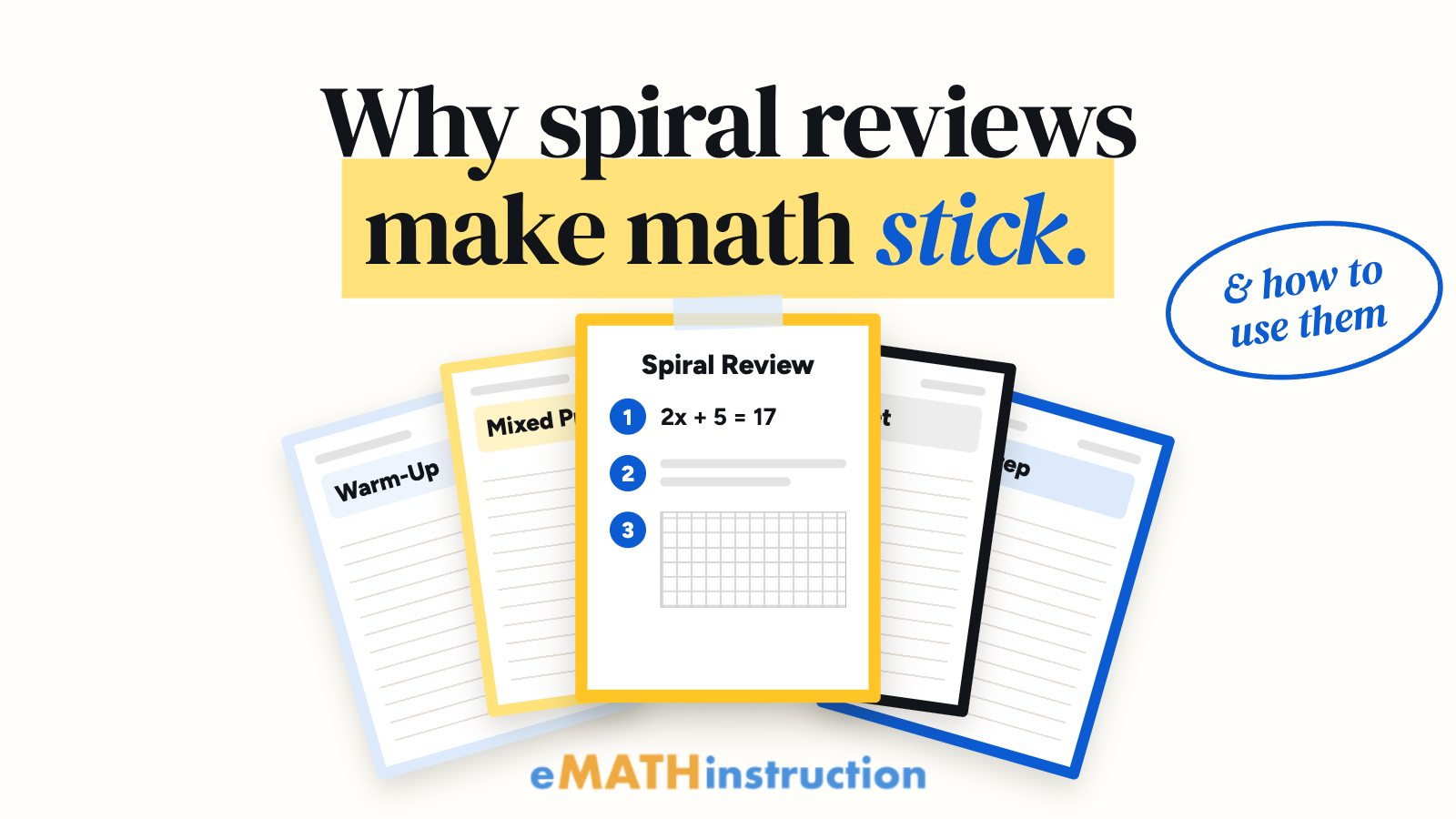
Spiral Reviews: What They Are and How to Use Them

Every math teacher knows the moment. It’s April, the class is deep into review season, and a student stares at a problem you taught back in September like it’s the first time. 

The skill was taught, practiced, and even tested. But sometime over the winter, it quietly slipped away.

Spiral reviews are built to stop that from happening. Our new eMATHinstruction spiral reviews are now available, and this guide walks through what they are, why the approach works, and how teachers are fitting them into the school day.

What are spiral reviews?

If you haven’t used this specific term, spiral reviews are a review method where old topics are practiced over time to retain key skills. They bring back past lessons in small chunks to help students move that learning into long-term memory.

They are not completed all at once. Students pull out their spiral review daily and complete a set number of pages, or work on it for a set period of time. Spacing out the review is what makes it stick, and it gives students a routine.

The payoff comes later. When exam time or a new topic comes around, students don’t need to relearn what was covered months earlier, because they’ve been keeping it fresh all along. Think of spiral reviews like a mini recap of what the school year has been covering.

Why spiral reviews work so well

Spiral review rests on two effective findings in learning science: spacing practice out over time, and mixing different problem types together.

  1. Spacing beats cramming. Researchers have studied the “spacing effect” for more than a century. A 2006 meta-analysis found that spreading practice out reliably improves retention compared with massing it together. A 2025 review of classroom studies, covering more than 3,000 students, found a moderate advantage for spaced over massed practice, with bigger gains when the test came long after the learning. With a spiral review, students retrieve old skills from memory, on a schedule spread across the year.
  2. Mixing topics beats blocking them out. Most math homework is “blocked”: 20 problems on the same skill, right after that skill is taught. Students can get every one right without having to decide which method to use. Spiral reviews mix topics together, which is closer to what students face on a cumulative exam. In a Scientific American study, students who practiced with mixed homework scored 25 percent higher on a surprise test the next day. When the test came a month later, the advantage grew to 76 percent.

A couple things from the research are worth knowing. First, mixed practice works best once students have already learned each skill on its own, so spiral reviews should revisit lessons that have already been taught. Second, mixed practice takes a bit more time and feels harder in the moment. That ‘struggle’ is part of why it sticks.

Why we built them

Spiral reviews were the most requested resource that teachers asked us for. 

If a student sees a concept in September and doesn’t touch it again until the state test in June, it’s gone. Teachers see this issue every year, when review week turns into reteaching week. 

We wanted to take that work off your plates. Spiral reviews keep every concept warm all year instead of leaving it to fade between the unit test and the final exam months later.

How to use them

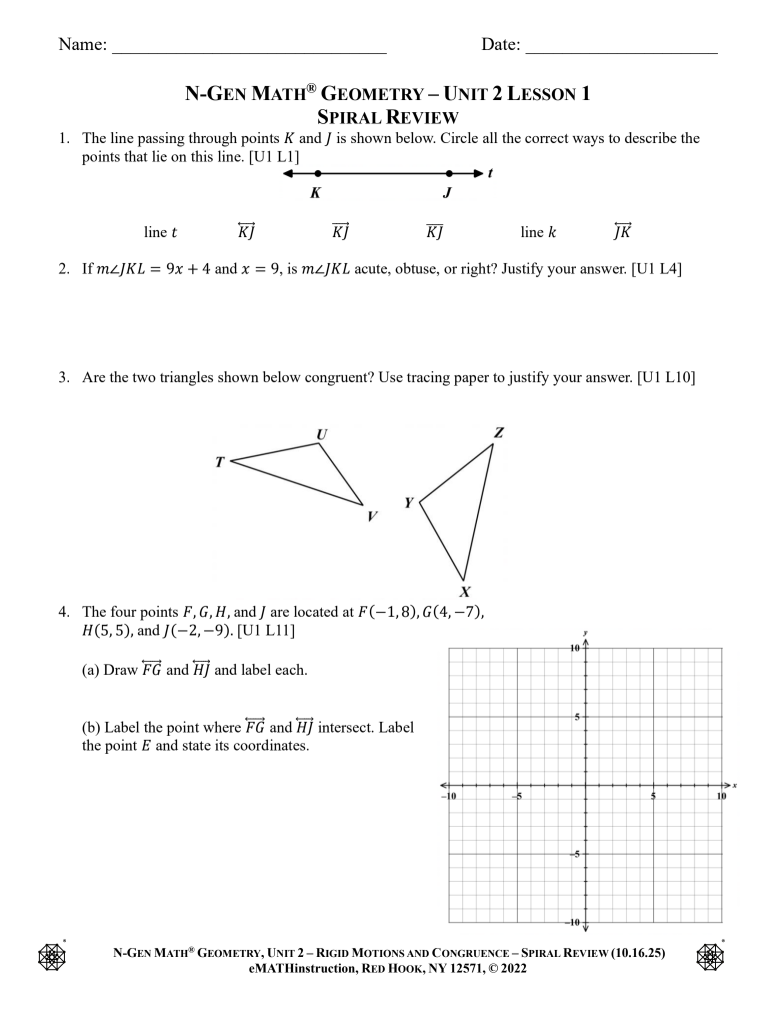
The piece that makes spiral reviews workable is that they aren’t meant to be done in one sitting. In our spiral reviews, each page is a single lesson’s worth of five problems, so most teachers have students do one page at a time.

Five problems usually take 5 to 10 minutes. That’s short enough to fit into almost any class period without giving up time for what you’re currently teaching.

These are the setups we hear about most often.

  1. As a bell ringer. Students pick up the day’s page as they walk in and get to work while you take attendance. Then, you can either project the answers at the 8-minute mark, have students check their own work, or ask for a show of hands on the problem that gave the class the most trouble. That one problem becomes a two-minute mini-review before the new lesson starts.
  2. As an exit ticket. Another option is the last 7 minutes of class go to the day’s spiral page, and students hand it in on the way out. It’s a quick check on what has stuck from earlier units, and the stack is small enough to sort that evening into “got it” and “needs another look.”
  3. Attached to the day’s lesson or homework. Some teachers add the spiral page to the end of the night’s homework. Students practice the new skill then revisit five older ones, so review happens every day without taking class time.

For example, hand out this Unit 2 Lesson 1 review when you’ve already finished teaching Unit 1. Since kids have already moved onto the new material, spending 5 minutes at the beginning of class flexing the muscle keeps Unit 1 in their memory. The further along you are in the school year, the more units are fair game for a spiral review. This turns old material from “I forgot how to do this” into “I can still do this”.
 

There’s no single right way. It’s up to you. Some teachers rotate between setups depending on the day, using a bell ringer on a full period and moving it to homework on a shortened assembly schedule. What matters most is the rhythm of a spiral review: a little bit, often, all year long.


What teachers like about them

Beyond the retention benefits, there are a few other reasons that teachers like spiral reviews, and why they came so highly requested. 

  • Every question is tagged. Each problem lists the unit and lesson it came from. When a student misses one, you know exactly which lesson to send them back to, with no guesswork about where the gap started.
  • Mixed topics make students think. Because the five problems come from different lessons, students have to decide which strategy applies before they start and pull it from memory without relying on patterns. That’s a different skill from running 20 of the same problem on autopilot, and it’s the skill a cumulative test demands.
  • It’s helpful teacher data. A glance at a week of spiral pages shows what’s slipping. You can catch it weeks before a test, rather than discovering it during review week.
  • End-of-year review stops being a cram session. When students have been revisiting older topics all year, less is lost. Spring review can act as a refresher instead of a rescue mission.

How to get started

Here are some ideas that work well for teachers in the first few weeks of using spiral reviews:

  1. Pick one setup and stick with it for two weeks. Bell ringer, exit ticket, or homework add-on. Consistency is what turns it into a habit for students.
  2. Start with pages from lessons your class has already covered. Spiral reviews are for strengthening what’s been taught, not introducing new material.
  3. Go over answers quickly. A few minutes of self-checking or a quick show of hands is enough. The goal is retrieval, not a graded quiz.
  4. Use the lesson tags. When a problem trips up several students, the tag points you straight to the unit to reteach.
  5. Expect it to feel harder at first. Mixed practice is more effort than a page of identical problems. That effort is the point, and students settle into it within a few weeks. It’s normal for them to struggle a bit at first.

Five problems a day doesn’t sound like much. But spread across a school year, it adds up to hundreds of chances to keep old skills from slipping away, and a spring review season that finally feels manageable.

More eMATH instruction tools

Search

Most Popular

Spiral Reviews: What They Are and How to Use Them
Spanish Translations Are Now Available on eMATHinstruction
Schools Are Rethinking Screen Time. What Does That Mean for Math Classrooms?

For Administrators

Bring eMATHinstruction to your school

For Teachers

Get started with a free trial

Math Tools that Make Teaching Easier

Lesson planning, grading, and organizing materials can take up hours of precious time. Having ready-to-use resources means less stress and more space to focus on students. With the right tools, teachers can spend their energy on what matters most: inspiring a love of math and helping every learner succeed.

Related Posts

Spanish translation

Spanish Translations Are Now Available on eMATHinstruction

Every eMATHinstruction lesson video now includes Spanish audio and Spanish captions, making it easier...
Screentime

Schools Are Rethinking Screen Time. What Does That Mean for Math Classrooms?

By eMATHinstruction Multiples of Whole Numbers are Everywhere In the early units of our middle school...
Multiples and LCMs

Understanding Multiples and Least Common Multiples

By eMATHinstruction Multiples of Whole Numbers are Everywhere In the early units of our middle school...
We use cookies to offer you a better browsing experience, analyze site traffic, and personalize content. Read about how we use cookies and how you can control them in our Privacy Policy. If you continue to use this site, you consent to our use of cookies.
Terms and Conditions

Thank you for using eMATHinstruction materials. In order to continue to provide high quality mathematics resources to you and your students we respectfully request that you do not post this or any of our files on any website. Doing so is a violation of copyright. Using these materials implies you agree to our terms and conditions and single user license agreement.

Members Only

The content you are trying to access requires a membership. If you already have a plan, please login. If you need to purchase a membership we offer yearly memberships for tutors and teachers and special bulk discounts for schools.

Login or Purchase Membership
Teachers Only

Sorry, the content you are trying to access requires verification that you are a mathematics teacher. Please click the link below to submit your verification request.

Complete Verification

Share Your Experience with AI Tutor

"*" indicates required fields

Choose your AI tutor*

Get your free trial

To start your free trial, please log in to your account.

Sign In

Don’t have an account yet? Create one here.

Create an account

"*" indicates required fields

Name*
Password*

Have an account? Back to login.